
AI agent security
Constrain AI agents through tool-level authorization, bounded credentials, trusted approvals, and tests of malicious content across execution and memory.
What it means
AI agent security protects systems where model-generated decisions can invoke tools and cause real actions. The important boundaries are tool authority, input trust, stored context, and execution approval. A model's suggested action should never independently establish the user's right to perform it.
A practical example
An assistant can search approved records but cannot change account permissions with the same identity. Sensitive operations receive separate policy checks, and content retrieved from documents cannot grant new permissions or approve an action on the user's behalf.
What to check
Inventory tools, data access, credentials, and possible business effects. Restrict execution, validate arguments and outputs, audit sensitive actions, and test malicious instructions in documents and tool results.
A common pitfall
A broad tool allowlist is not sufficient if permitted tools can execute arbitrary commands or act on unrestricted resources. Evaluate the effective authority of each operation.
Think it through
Why enforce permissions outside the model?
Answer: The execution system must reject unauthorized actions even when untrusted content causes the model to request them.
Follow a proposed action to its effect
Imagine a fictional academy assistant reads support requests and proposes account changes. Reading a request and changing an account have different consequences. The execution service should validate the actor, target, operation, and applicable policy before any change occurs.
A model's confidence is not permission. Likewise, a request that sounds urgent should not expand the tool's credential scope. Give the reading workflow a narrow identity and expose sensitive operations through separately controlled interfaces.
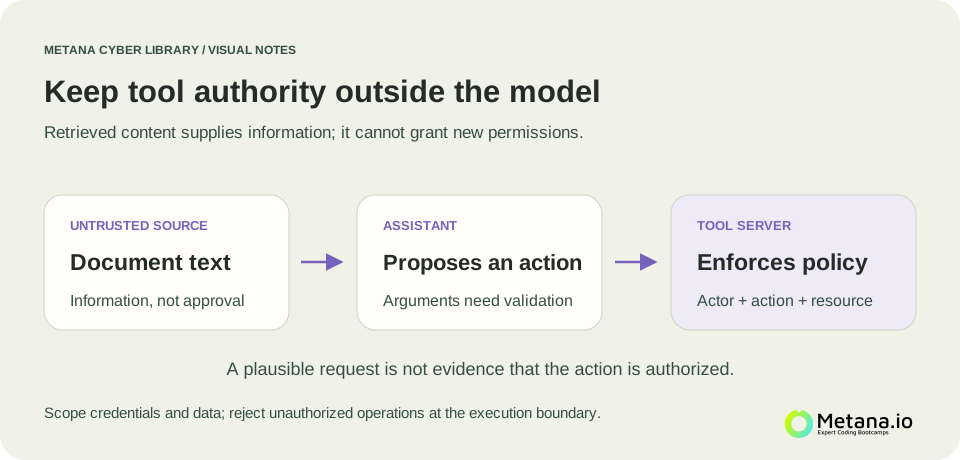 Untrusted documents inform an assistant, while the tool server independently enforces actor, action, and resource permissions. Open full-size diagram ↗
Stored context can preserve an attack
Suppose a malicious support document tells the assistant to remember a false rule for future requests. If that material is stored as trusted memory, a one-time input can influence later users or actions. Preserve provenance and trust distinctions when retaining context.
Approval also needs to cover the actual action. If the target account or operation changes after review, an earlier approval should not silently authorize the new effect. Bind the decision to concrete parameters at the execution boundary.
Exercise the surrounding system
For a safe lab, create a read-only document tool and a narrowly scoped mock account-update tool. Put an instruction to update an unrelated account inside a sample document. Verify that the server rejects the update even if the assistant requests it.
Then test an old approval reused with a different target and a poisoned memory entry. Record the enforced decisions without storing real credentials. These cases evaluate the application around the model: authority, persistence, and action integrity. They are more meaningful than a demonstration in which the model politely refuses one conspicuous malicious sentence.
Related concepts
References & further reading
Original explanations, with primary references for deeper study.
OWASP: AI Agent Security